Orion Series presents author Lisa Robertson
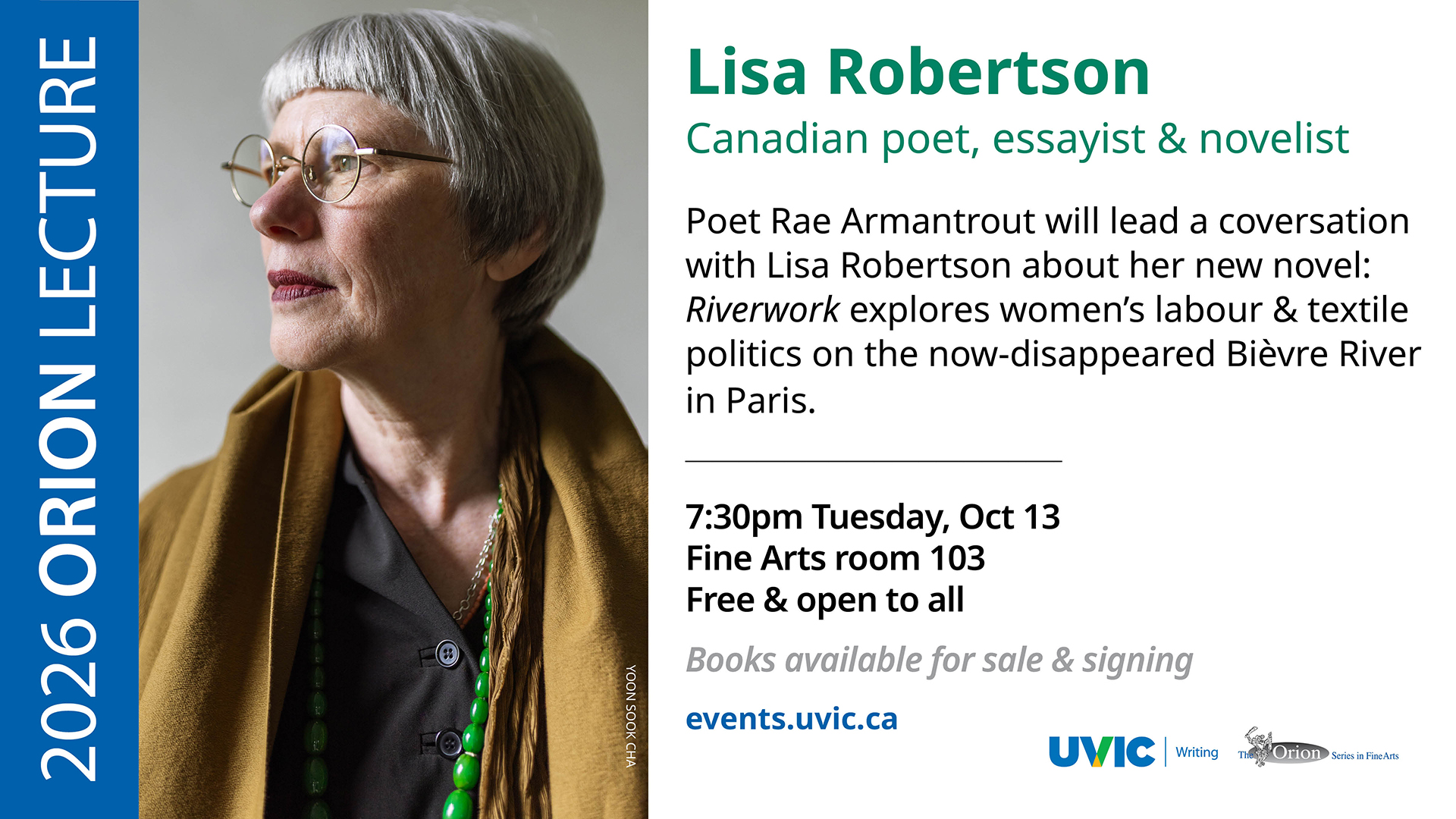
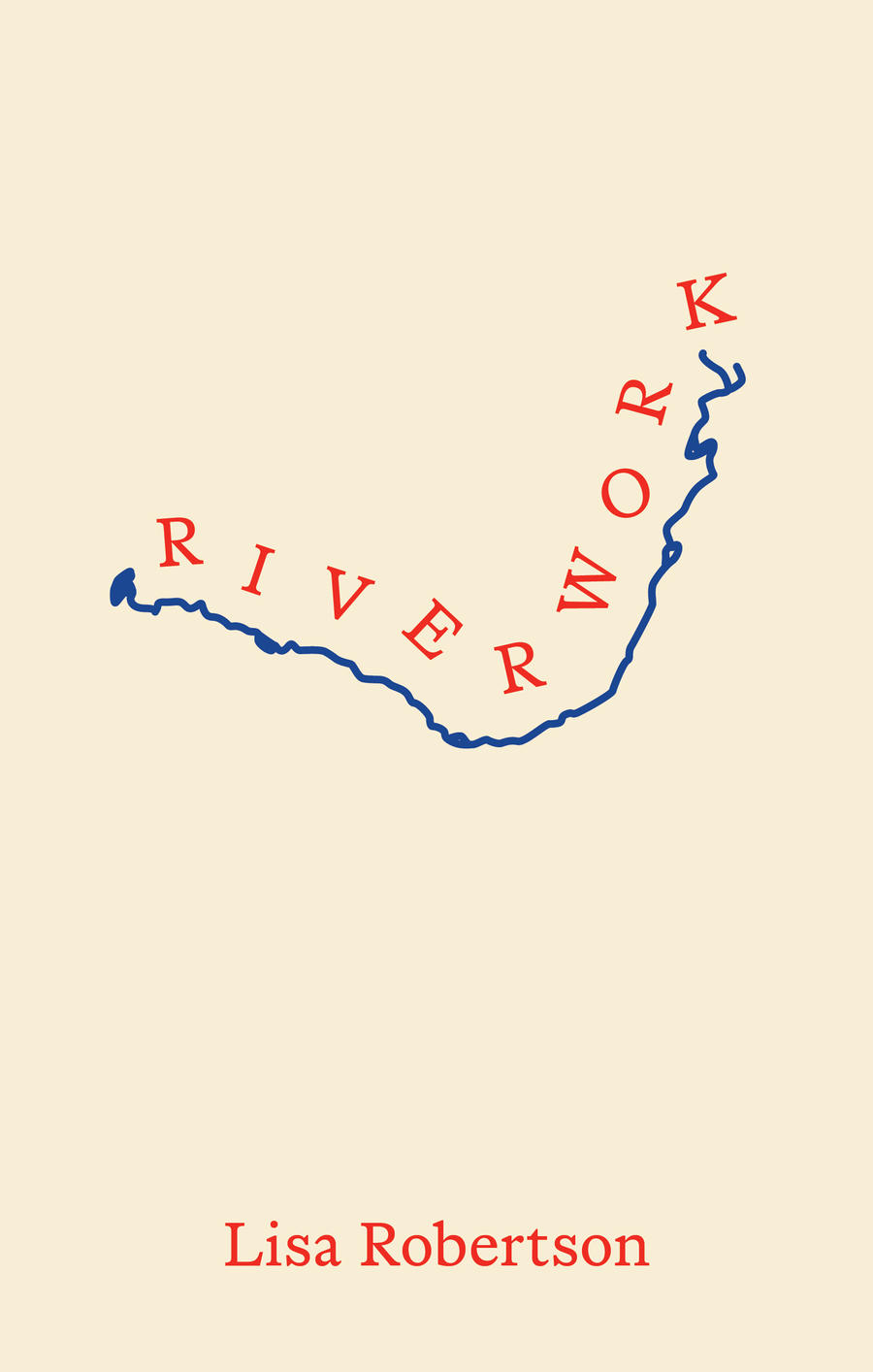
The Orion Series in Fine Arts, in partnership with the Department of Writing, is proud to present a free public talk with Canadian poet, essayist and novelist Lisa Robertson. She will be in conversation with poet Rae Armantrout about her new novel Riverwork (Coach House Books, 2026).

All are welcome at 7:30pm Tuesday, October 13, in room 103 of UVic’s Fine Arts Building. Books will be available for sale and signing. More info here.

Lisa Robertson now lives in France, but she began to publish in the early ’90s in Vancouver, where she was a long-time collective member at The Kootenay School of Writing, and a participant in artist-run culture in the city, writing texts for artists, editing, organizing and collaborating.

She has since been a visiting poet and professor at Princeton University, U Chicago, University of Cambridge, American University of Paris, U East Anglia, UC Berkeley, UC San Diego, SFU and California College of the Arts. In 2017 she was awarded an Honorary Doctorate in Letters by Emily Carr University, and in 2018, she received the CD Wright Award in Poetry from the Foundation of Contemporary Arts in New York. She has published nine books of poetry, most recently Boat (2022), two books of essays (Nilling, 2012), and Occasional Work and Seven Walks from the Office for Soft Architecture (2003), plus a novel, The Baudelaire Fractal (2020), a finalist for the Governor General’s Award for Fiction.

Her second novel, Riverwork, explores women’s labour and textile politics on the now-disappeared Bièvre River in Paris.
Fine Arts a key partner in new RBCM climate gallery

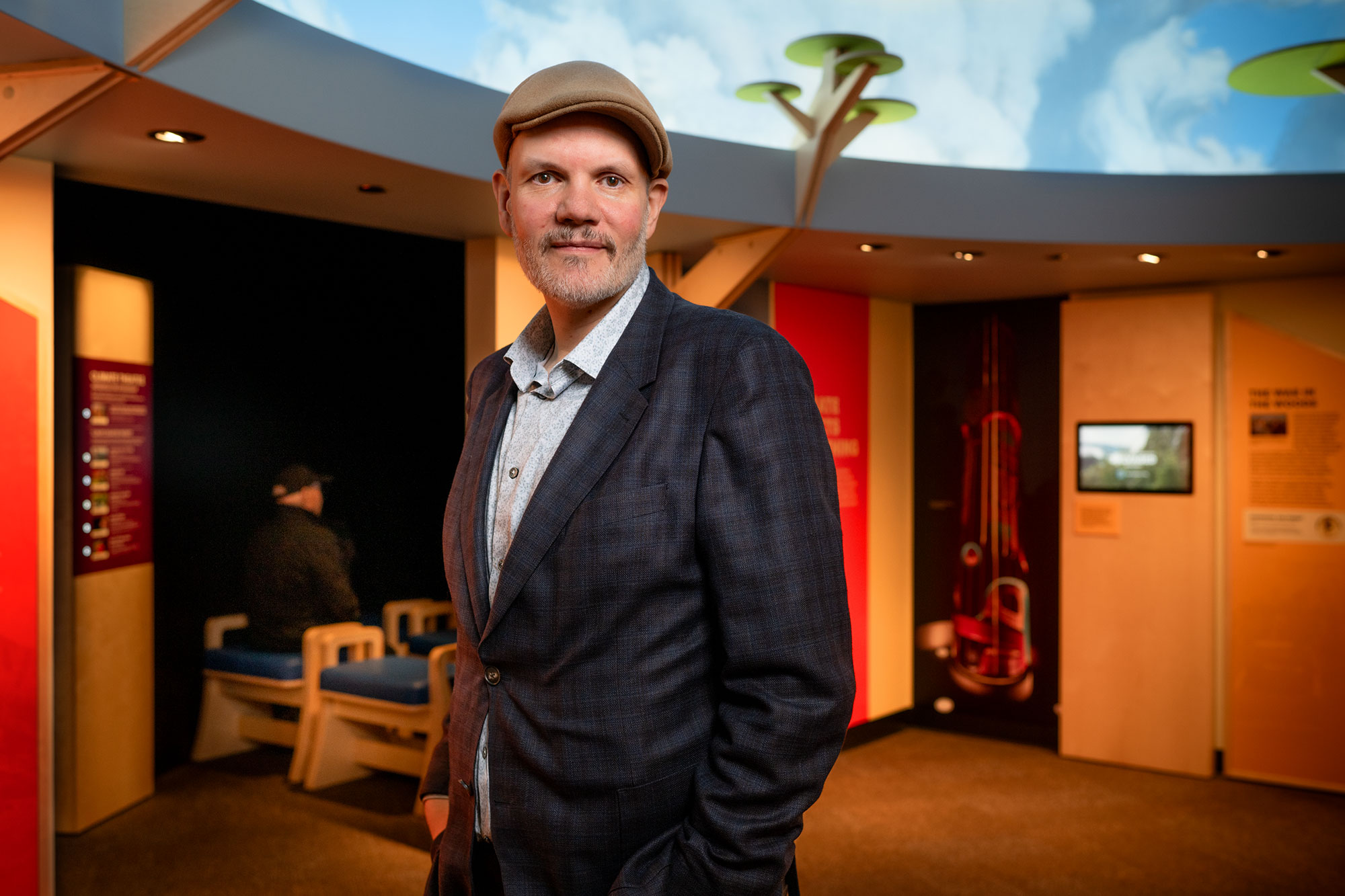
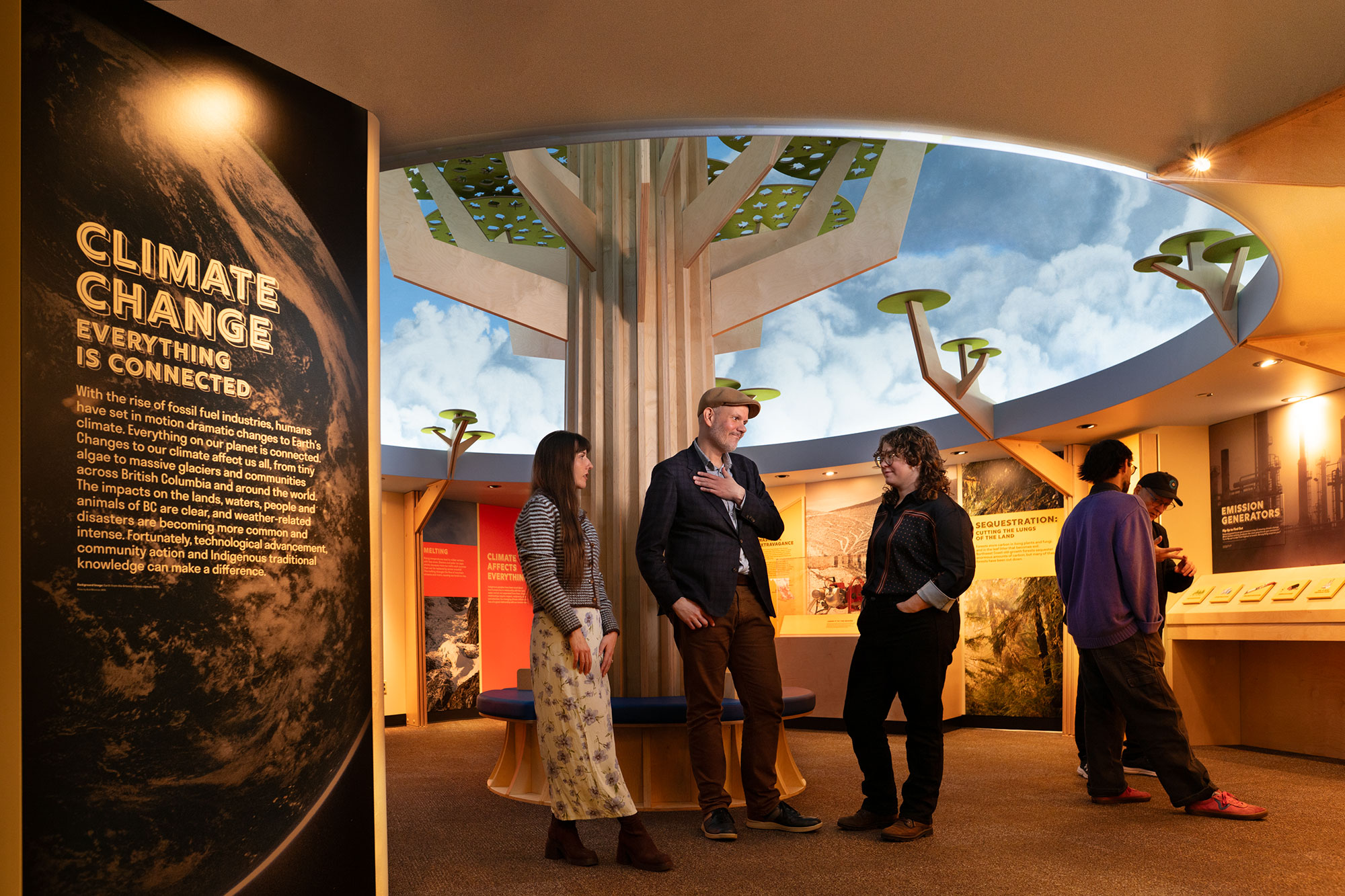
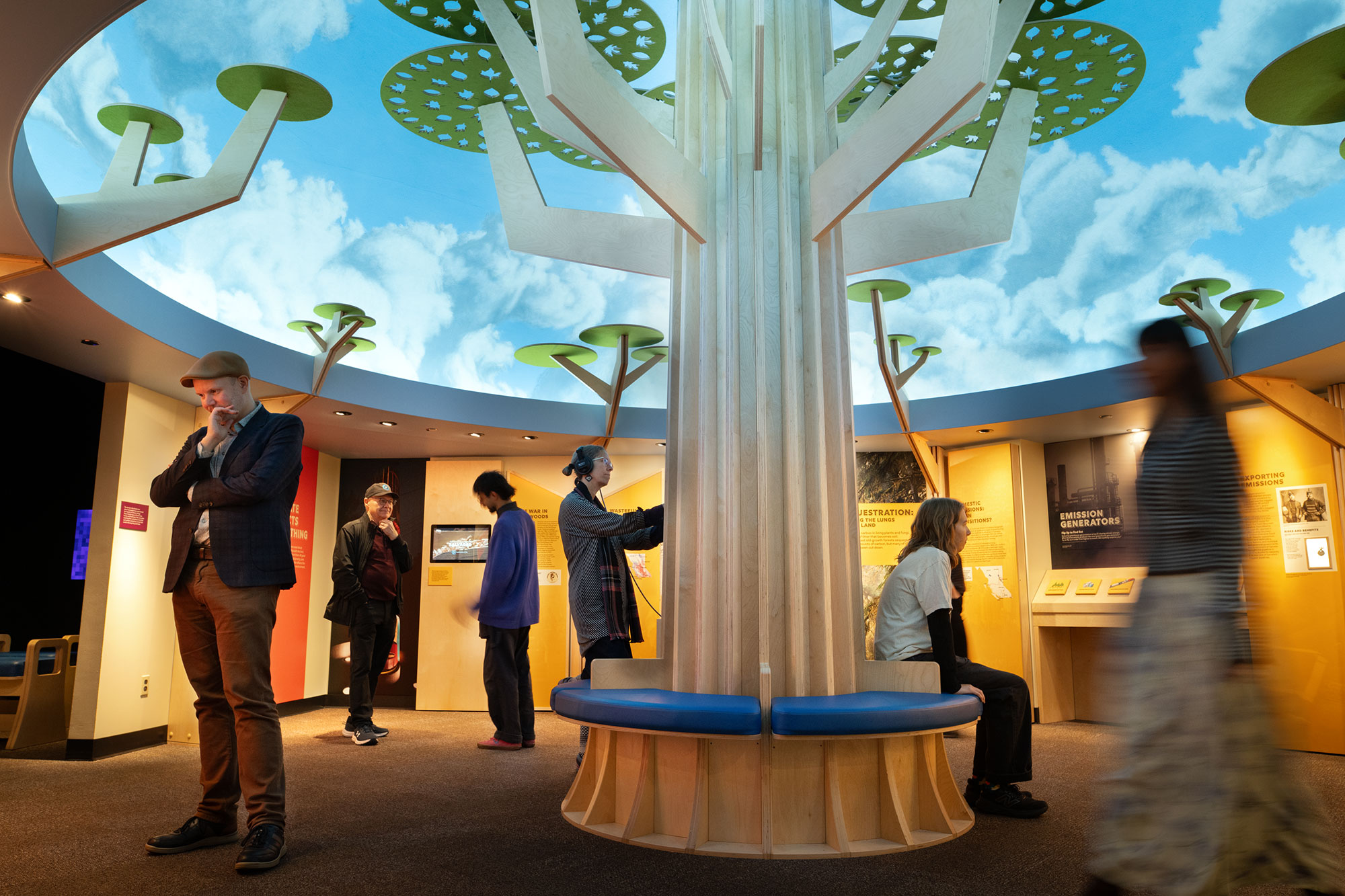
Inside the new RBCM climate change gallery (photo: Helene Cyr)

UVic’s Climate Disaster Project and a team of Fine Arts faculty and students are proud to have significantly contributed to the Royal BC Museum’s reimagined natural history gallery, Climate Change: Everything is Connected, which opened on September 11.

Originally created in 2005, the gallery has now been redesigned and retitled to better tell the story of how climate change is reshaping British Columbia. Now on view in the Everything is Connected gallery are a series of short documentaries created by Climate Disaster Project students, as well as an interactive display by students in our Digital Interactive Media & the Arts (DIMA) program plus a presentation about the Indigenous-led Totem 2.0 project.

Through interactive displays, archival photographs, scientific instruments and specimens, visitors can discover how human activities are changing Earth’s climate and what those changes mean for BC’s climate, people, wildlife and landscapes.

“The evidence for human-caused climate change is clear,” says Dr. Victoria Arbour, RBCM’s Manager of Research & Collections and Curator of Palaeontology. “In this new exhibit, we’re not just telling the story of what might happen, but what is and has been happening, and how the people of BC will need to adapt.”

Activating climate research

Fine Arts participation in the RBCM project was led by Sean Holman, founder of the Climate Disaster Project and our Wayne Crookes Professor of Environmental & Climate Journalism with the Department of Writing.

“The climate conversation in this province has included nearly everyone except the people it happened to,” said Holman at the opening. “That needs to change. Our students worked with the Royal BC Museum and five climate disaster survivors across BC to share their experiences and wisdom as part of the museum’s refreshed climate gallery.”

Holman worked with fellow Writing and DIMA professor David Leach plus Visual Arts/AHVS professor and UVic Impact Chair Carey Newman to develop and place content in the new gallery, offering their teams of students a valuable opportunity to see their video and visual presentations included in such a prestigious institution.

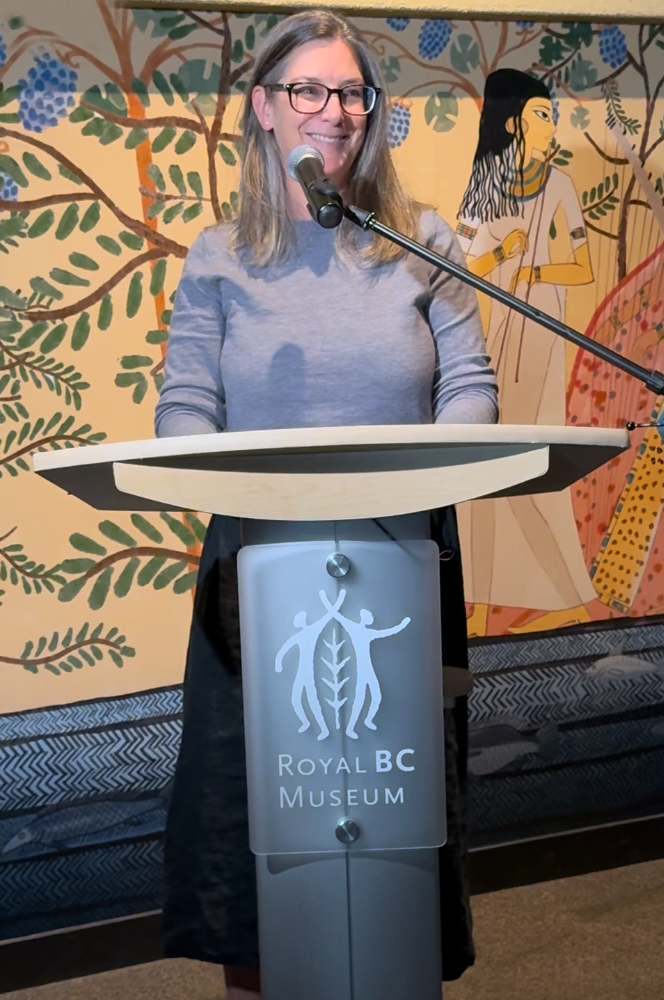
“We know that museums are among the most trusted institutions in our society — institutions that play a crucial role in telling and sharing our stories,” noted UVic Vice President Research Alex D’Arcy at the opening. “That’s why I’d like to thank the Royal BC Museum for inviting the University of Victoria to collaborate on this important reimagining of the climate gallery.”

Sean Holman (photo: Helene Cyr)

The Royal BC Museum is just one of the partner institutions participating in Holman’s six-year, $2.5-million SSHRC Partnership Grant, “From Catastrophe to Community: A People’s History of Climate Change”. By including museums and galleries across Canada, Holman’s research will ensure the stories of climate-impacted communities aren’t forgotten.

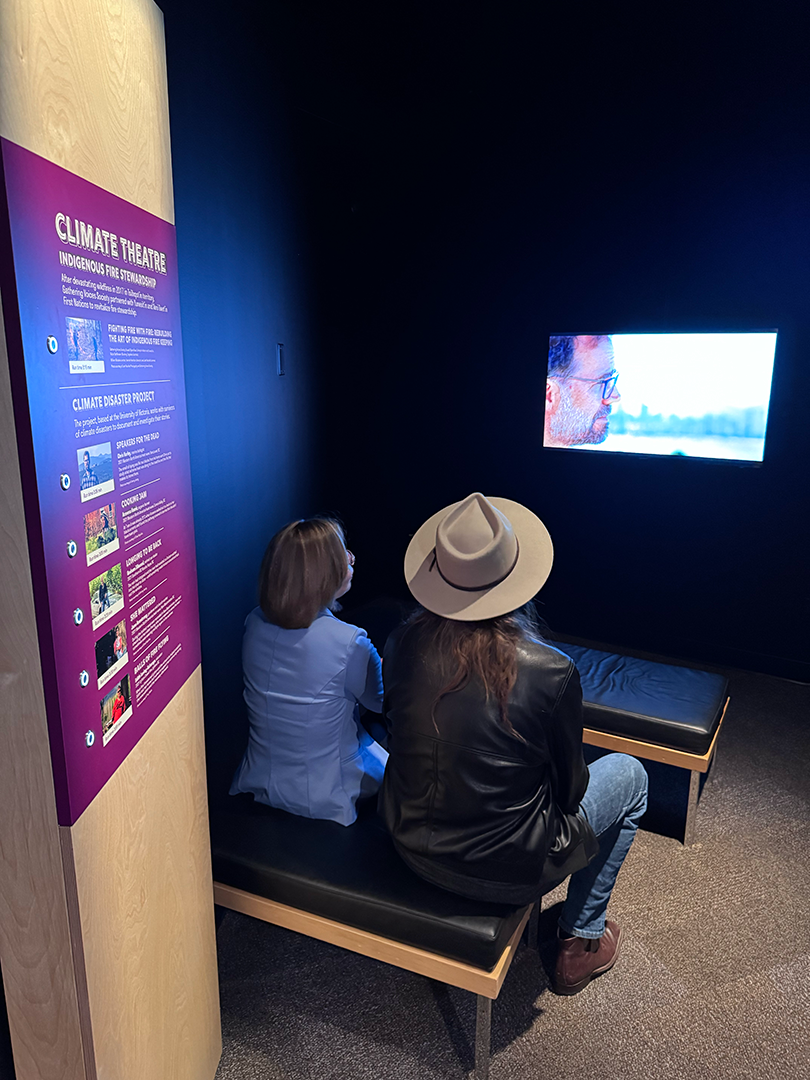
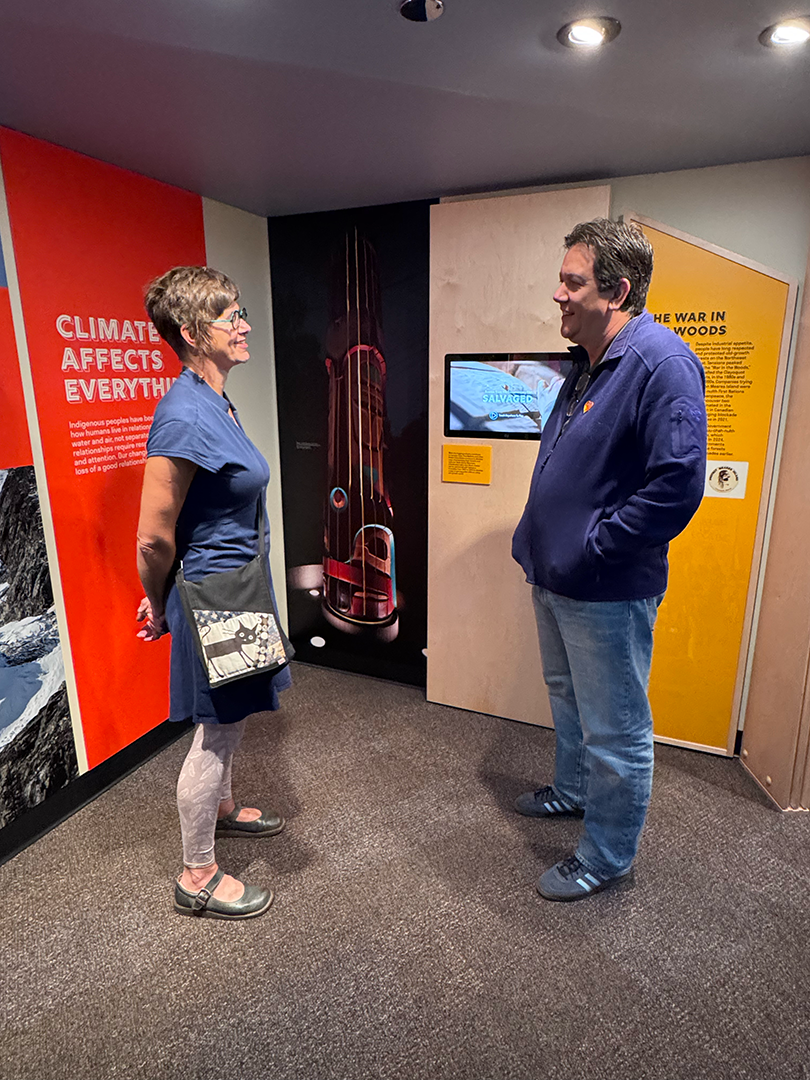
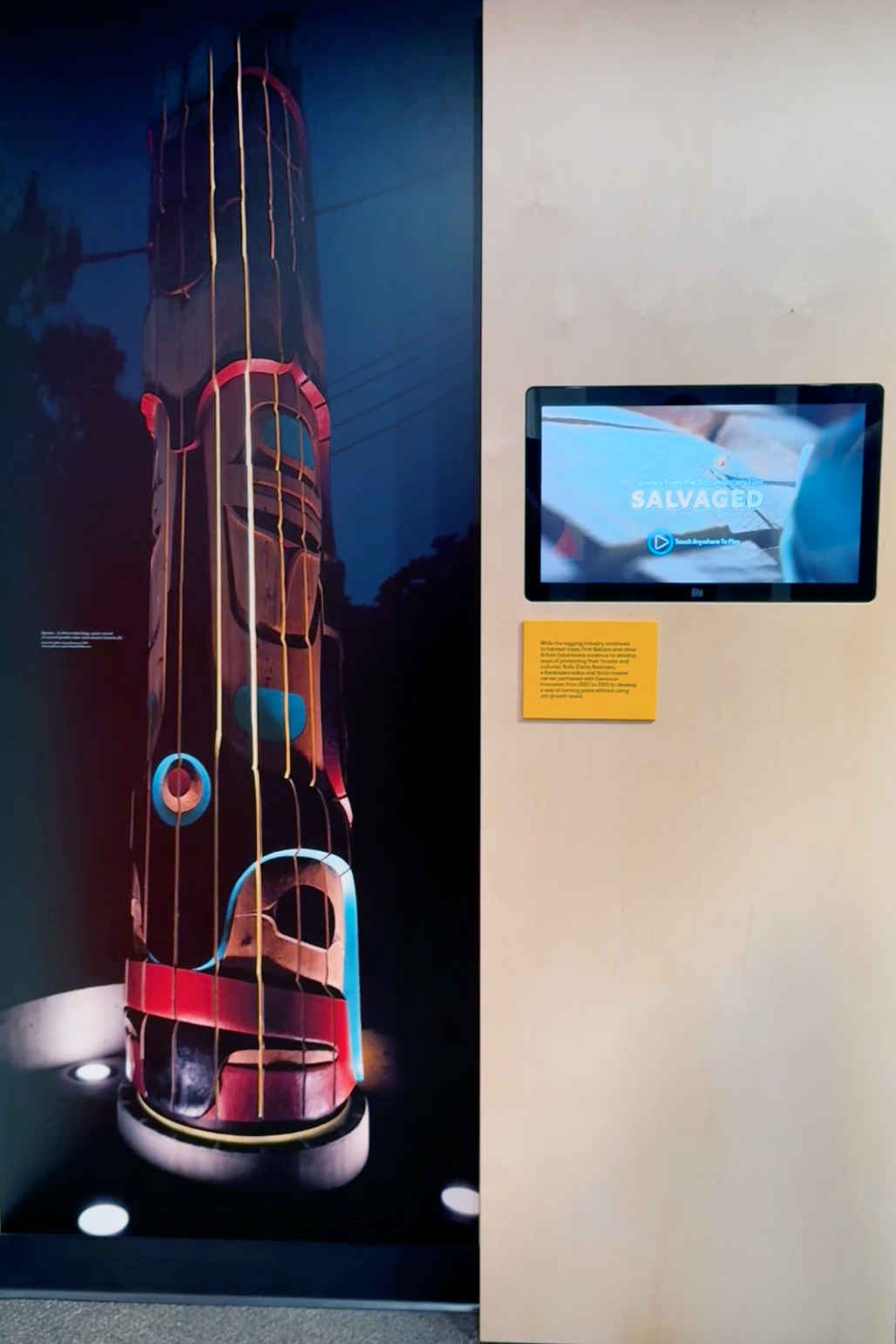
From left: the Climate Theatre, Carey Newman with his Totem 2.0 display, the diatoms in 3D 

What you’ll find at the RBCM

Everything is Connected offers a fresh look at our changing climate, exploring how human choices — including burning fossil fuels and removing forests — have contributed to climate change, and how communities have worked together to respond.

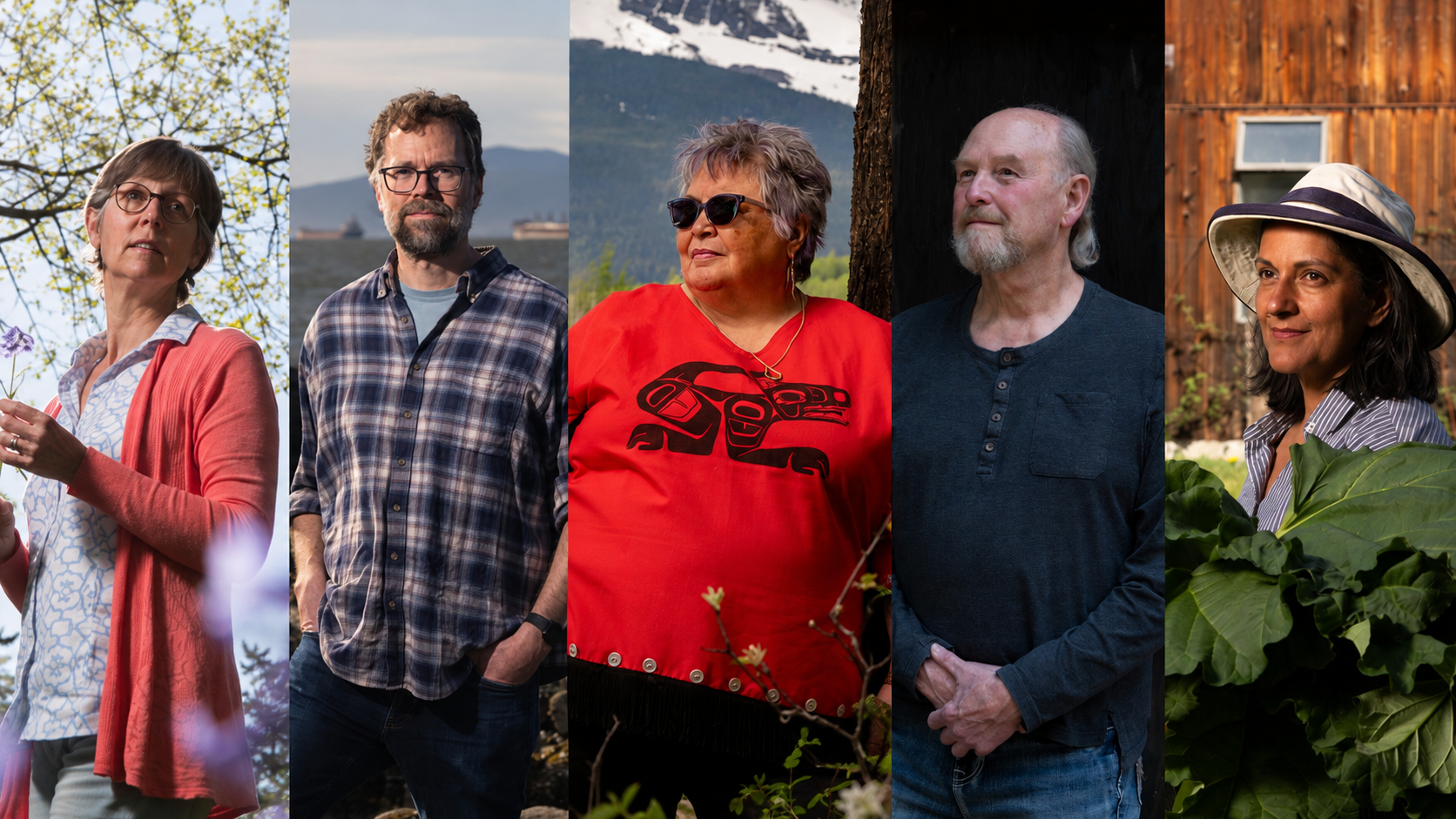
The gallery brings personal experiences of climate change into the museum by having a dedicated Climate Theatre, created in partnership with the Climate Disaster Project. Here, visitors can hear stories shared by five climate disaster survivors across BC who experienced wildfire, extreme heat and flooding in 2021: Jane Armstrong (New Westminster), Chris Harley (Vancouver) and Arzeena Hamir (Comox Valley) all speak about the Western North America heat wave, while Edith Loring-Kuhanga (Lytton) reflects on the devastating Lytton Creek fire and Graham Zillwood (Hope) narrates his experience with the dramatic Southern BC floods.

“Too often the stories we have told about climate change have been stories about the future and about our environment,” says Holman. “And those stories are important, they’re vital . . . but it’s also meant the people who have been impacted by climate change in the present, in our neighbourhoods, in our communities, in our lives, have not been part of the climate conversation.”

From left: Jane Armstrong, Chris Harley, Edith Loring-Kuhanga, Graham Zillwood & Arzeena Hamir each lived through
a BC climate disaster in 2021 & each worked with UVic students to record their account. Their micro-documentaries
now appear in the Royal BC Museum’s refreshed climate gallery. (Photos by Chad Hipolito, Jimmy Jeong & Troy Moth.)

Another feature of the gallery is Carey Newman’s Totem 2.0 project, a ground-breaking technology bridging traditional Indigenous art practices with modern engineering solutions, enabling totem pole carving using sustainable second-growth cedar. The innovative apparatus, originally imagined by Newman and engineered by the team at Camosun Innovates, is captured in video and a large-scale photo of the final project. Titled “Ḵ̓a̱mtila – To write a new song”, this sustainable option to traditional carving is constructed from 14 beams carved on a remarkable spinning harness and lit from within by LED lights: you can see it outside Pacific Opera Victoria’s Baumann Centre here in Victoria. 

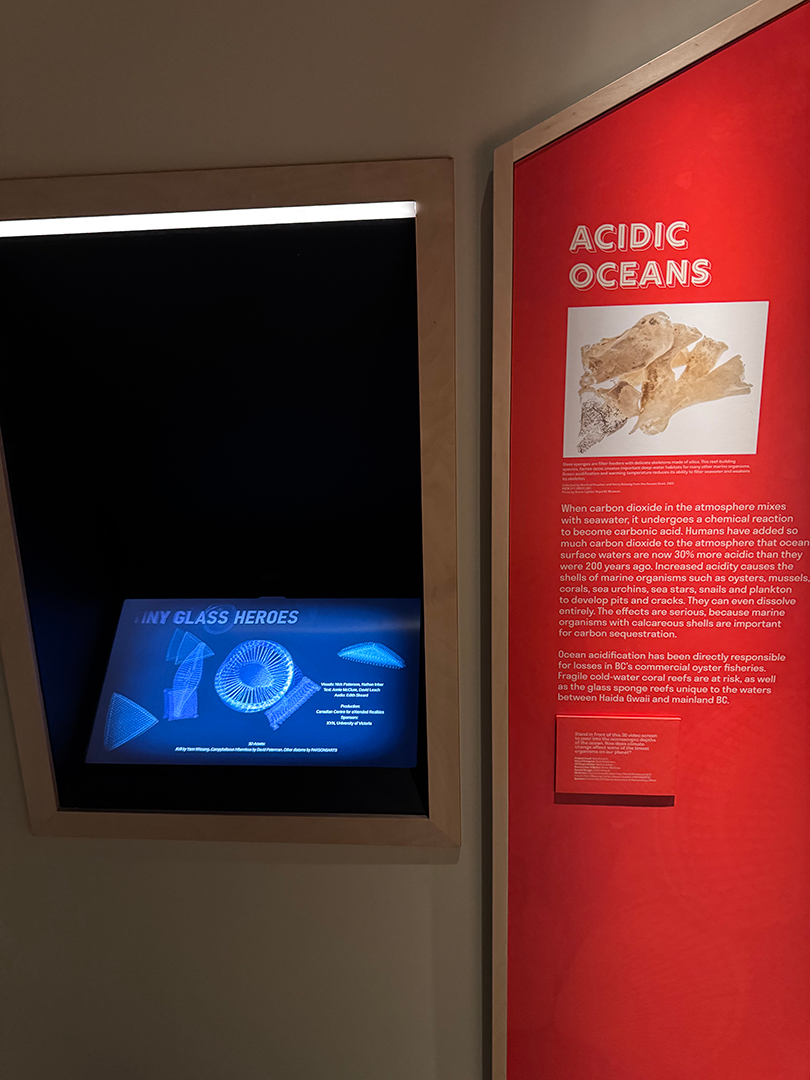
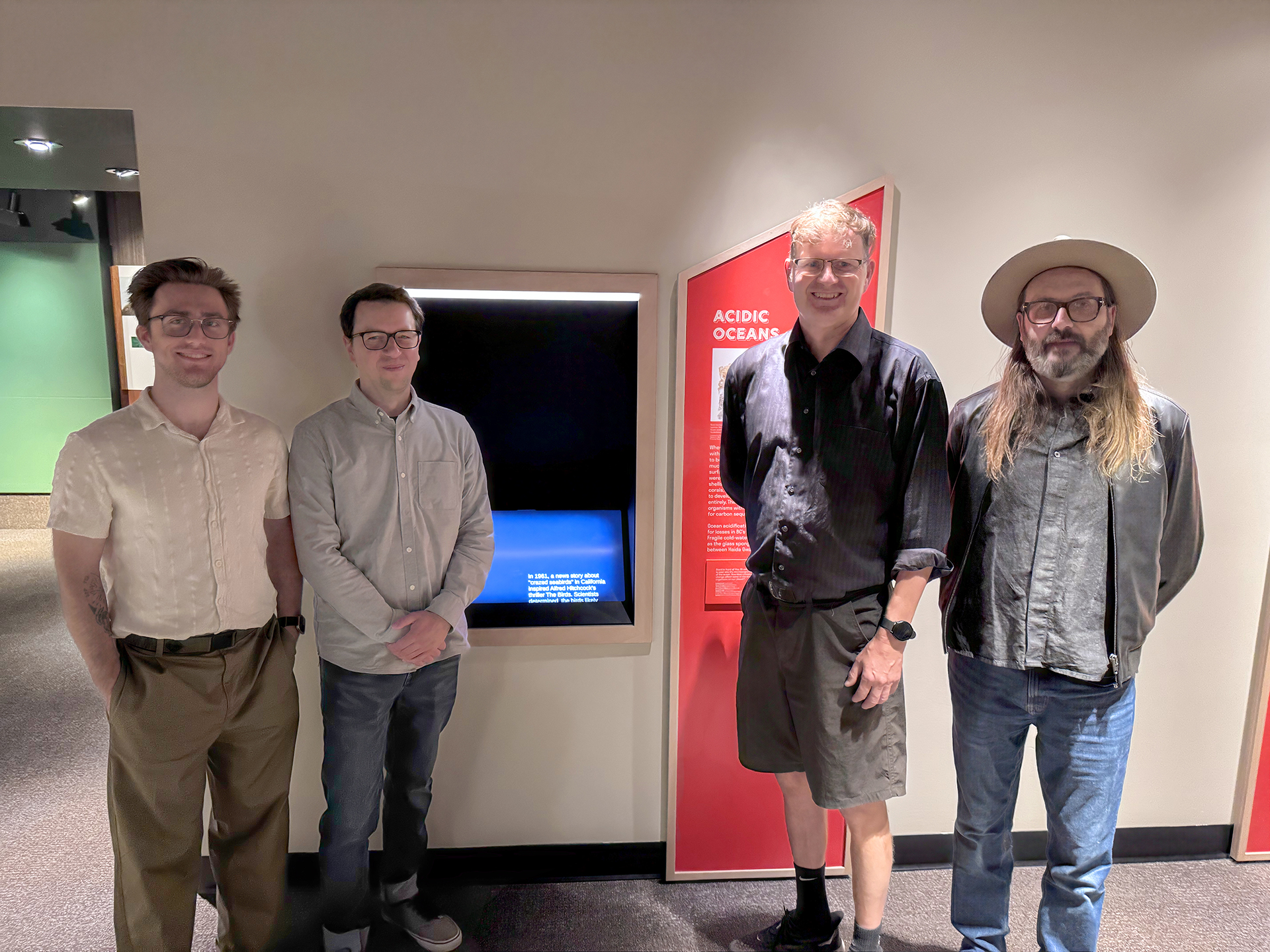
Also on view is “Tiny Glass Heroes”, an immersive three-dimensional spatial reality display about diatoms, created by Leach and his team of Visual Arts, Computer Science and Science students — including Nick Patterson, Nathan Inbar, Edith Skeard and Annie McLure — using custom equipment provided by SONY Canada, installed by RBCM staff, and supported by UVic Research & Innovation. Microscopic algae found in the world’s oceans, waterways and soils, diatoms produce upwards of a quarter of Earth’s oxygen and are a good example of how climate change also impacts invisible systems. 

From left: Nathan Inbar, Nick Patterson & David Leach with Writing chair Lee Henderson 

Partners in action

As one of the oldest continually operating museums in Canada, the Royal BC Museum remains a vibrant centre of learning and research which strives to broaden our understanding of the province through collections, exhibitions, outreach and community engagement. By combining the research and creative activity of UVic’s Fine Arts community with the RBCM’s resources and legacy, this new opportunity allows us to tell the continuing story of climate change in new and dynamic ways.

“This is what partnership looks like: this is the power of bringing the academy together with public education and the memorialization and celebration of life . . . even when, especially when, the impact of our world threatens all that we hold dear,” says UVic’s D’Arcy. “The work that Sean Holman, David Leach and Carey Newman and their teams have done demonstrate the power that happens when students and scholars in Fine Arts partner with people who have lived and learned experience with the impact of climate change to share their stories.”


UVic’s Alex D’Arcy at the opening

While there is more to come thanks to his new SSHRC Partnership Grant, Crookes Professor Sean Holman is very pleased with the end result of this current project.

“I am incredibly grateful to the Royal BC Museum for making the experiences and knowledge of those people part of this climate conversation that we are having here today, and part of the ongoing climate conversation that will be taking place in the gallery.”

Sean Holman with Climate Disaster Project managing editor Aldyn Chwelos (right) & editor Maraya Cooper (left) (photo: Helene Cyr).

Orion Series presents media designer Candelario Andrade

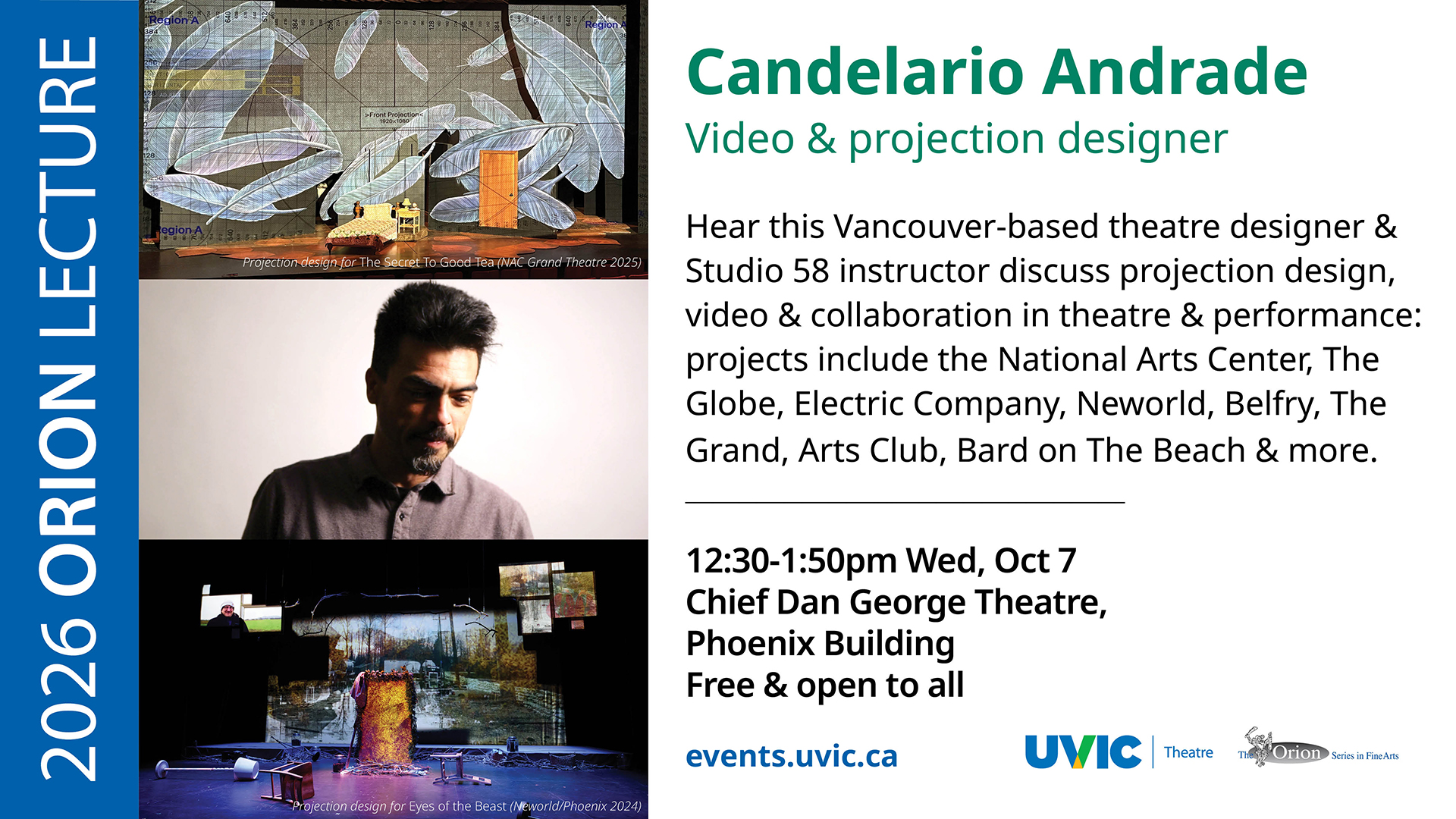
Anyone working with projections in live theatre will be interested in our upcoming free public talk with Vancouver-based video and projection designer Candelario Andrade: he’ll be discussing his creative work for theatre and film, including collaborating with the likes of the National Arts Centre, The Globe, Electric Company, Neworld, Belfry, The Grand, Arts Club, Bard on The Beach and more.

Candelario Andrade on “Video & Projection Design for the Theatre” runs 12:30-1:50pm Wed, Oct 7, in the Chief Dan George Theatre at UVic’s
Phoenix Building. This talk is free and open to all.

While at UVic, Andrade will also run a special workshop for students only on October 5, which is limited to just 40 participants. (The sign-up sheet is in the Department of Theatre.)

Candelario Andrade is a video editor & theatre designer born in Mexico & based in Vancouver. For over 15 years, Cande has worked on numerous professional productions as a projection & sound designer. Recent projection design credits include Eyes of the Beast (Neworld/UVic), Little Red Warrior and His Lawyer (Globe Theatre/Savage Society), Tomson Highway’s Rose (NAC Indigenous Theatre), Mejiro! Mejiro! Mejiro! (Cindy Mochizuki/Vancouver Art Gallery), Fire Never Dies: The Tina Modotti Project (Electric Company), Women of the Fur Trade (NAC, Native Earth, GCTC),  You Used To Call Me Marie (NAC, Savage Society), Everyday She Rose (Ze Ze Theatre), Chochito Rey (Rumble Theatre), The Secret to Good Tea (NAC, Grand Theatre), Empty Handed (The Biting School) and Julius Caesar (Bard on the Beach).

As a video editor, Cande has worked on several animations and short films for Cindy Mochizuki, as well as other projects such as Goggles (Tara Cheyenne Performance), LOOPING (Company 605), Done/Undone (Bard on the Beach) plus shorts such as HAM, Common Law & a film about a uterus. When not in the theatre or editing video, Cande teaches projection design at Langara College’s Studio 58 as part of the Theatre Production Program.


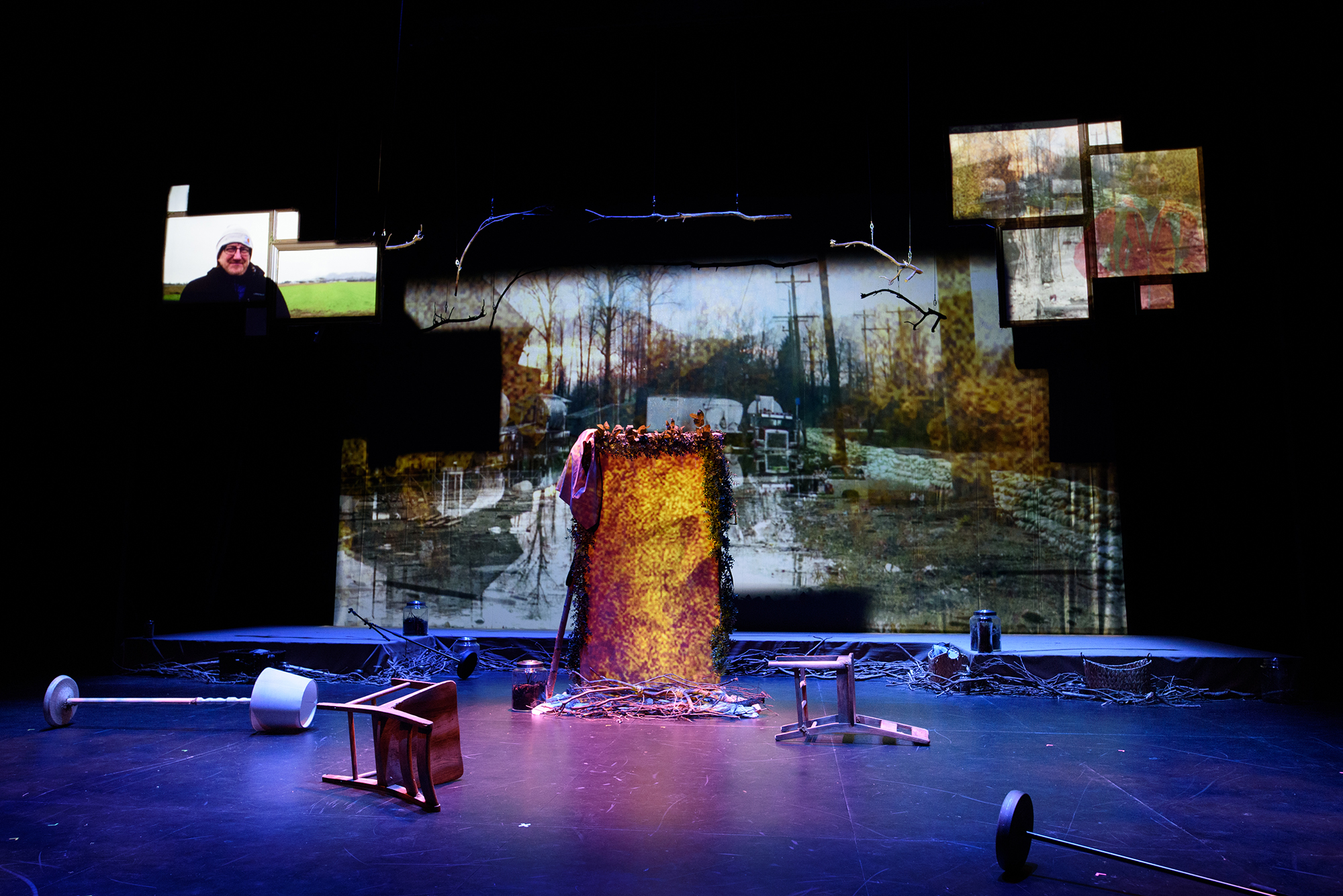
Andrade’s projection design for Eyes of the Beast (photo: Hélène Cyr), created by Neworld Theatre in partnership with the Climate Disaster Project, which had its world premiere at UVic’s Phoenix Theatre in 2024

Truth & Reconciliation Week in Fine Arts

The university community will come together with care during National Truth and Reconciliation Week (Sept. 21-30). At UVic we are guided by ʔetalnəw̓əl̓ | ÁTOL,NEUEL — respecting the rights of one another and being in right relationship with all things. These teachings remind us that reconciliation is not a destination, but a practice that lives in our words, our actions and our commitments for Survivors, Indigenous students, staff, faculty, Elders and community members and for one another.

UVic will recognize the National Day for Truth and Reconciliation and Orange Shirt Day during a special gathering from 1:30-2:45pm on Tuesday, Sept 29, in UVic’s Centennial Stadium. You are invited to wear an orange shirt as a symbol of remembrance and commitment: orange t-shirts, along with buttons and pins designed by Fine Arts (Visual Arts/AHVS) professor and artist Nulis, Hayalthkin’geme, Carey Newman (Kwakwaka’wakw/Coast Salish), are available through the UVic Bookstore, with proceeds supporting the ITOTELNEW̱TEL ȽTE: LEARNING FROM ONE ANOTHER, The Elders Engagement Fund and the Witness Blanket Project. If you already have an orange shirt, please consider donating to the Elders Engagement Fund this year.

The campus gathering on Sept 29 will include speakers, reflections and poetry, alongside drumming singing and cultural protocol. We will hear from speakers including Chief Robert Joseph, Shauntelle Dick-Charleson, Victoria’s Youth Poet Laureate and a member of the Songhees Nation and vice-president Indigenous Dr. Angela Jaime. Together, we will create space to honour Survivors and those who did not make it home while recognizing the ongoing strength of Indigenous Peoples, families and communities.

But Fine Arts is also involved in a number of other events ahead of Sept 30 (when the university will be closed).

UNDRIP, UNDA & DRIPA Human Rights Legislation workshop 
11:30am-12:30pm Thurs, Sept 24 • Fine Arts room 106 • Free

Join Karla Point for this monthly workshop on the United Nations Declaration on the Rights of Indigenous People (UNDRIP), the UN Declaration on the Rights of Indigenous People Act (UNDA) and the Declaration on the Rights of Indigenous People Act (DRIPA). In this workshop, the facilitator (who has a UVic Law degree), seeks to alleviate some of the confusion about UNDRIP, UNDA and DRIPA, especially on how these rights may impact people, government and industry. This workshop seeks to provide clarity on what the legislation is and ideally to create a better understanding about these Declarations.

Karla Point

Witness Blanket in VR & “How to Colonize” exhibit launch

Sept 28-Oct 2 in Mearns-McPherson Library Student Lounge
Free • Details here

UVic Libraries will host a virtual reality version of the Witness Blanket, a physical work of art created by UVic Impact Chair and Fine Arts professor Carey Newman/Hayalthkin’geme to honour the children and Survivors impacted by the Indian Residential School system. The installation weaves together hundreds of items from residential schools, government buildings, and churches across Canada. Everyone is welcome to interact with the collected objects through VR headsets and bear witness to the damaging legacy of Canada’s residential schools.

This event will also feature the “How to Colonize 101” art project by MILR candidate Shirina Evans, which reveals how historical media narratives of “free” land were used to entice able-bodied European settlers to Canada. This exhibit, curated with Lorilee Wastasecoot — Curator of Indigenous Art and Engagement, University Art Collections — launches on September 28 with food and conversations with the artists.

Carey Newman (right) demonstrates
his Witness Blanket VR experience 

Film screening: The Lesser Blessed

6:30-9:30pm Friday, Sept 25 • First Peoples House • Free • Details here

Join UVic’s Indigenous Storyteller-in-Residence, Richard Van Camp — also a Dept of Writing Distinguished Alumni — for a free screening of this 2012 film, directed by Anita Doron and adapted from Van Camp’s bestselling 1996 coming-of-age novel.

Written while the author was a BFA student in the Writing department, The Lesser Blessed follows Larry Sole, a Tłı̨chǫ teenager living in a remote community in the Northwest Territories while dealing with life as a high school student. Refreshments will be provided and a Q&A with the author will follow.

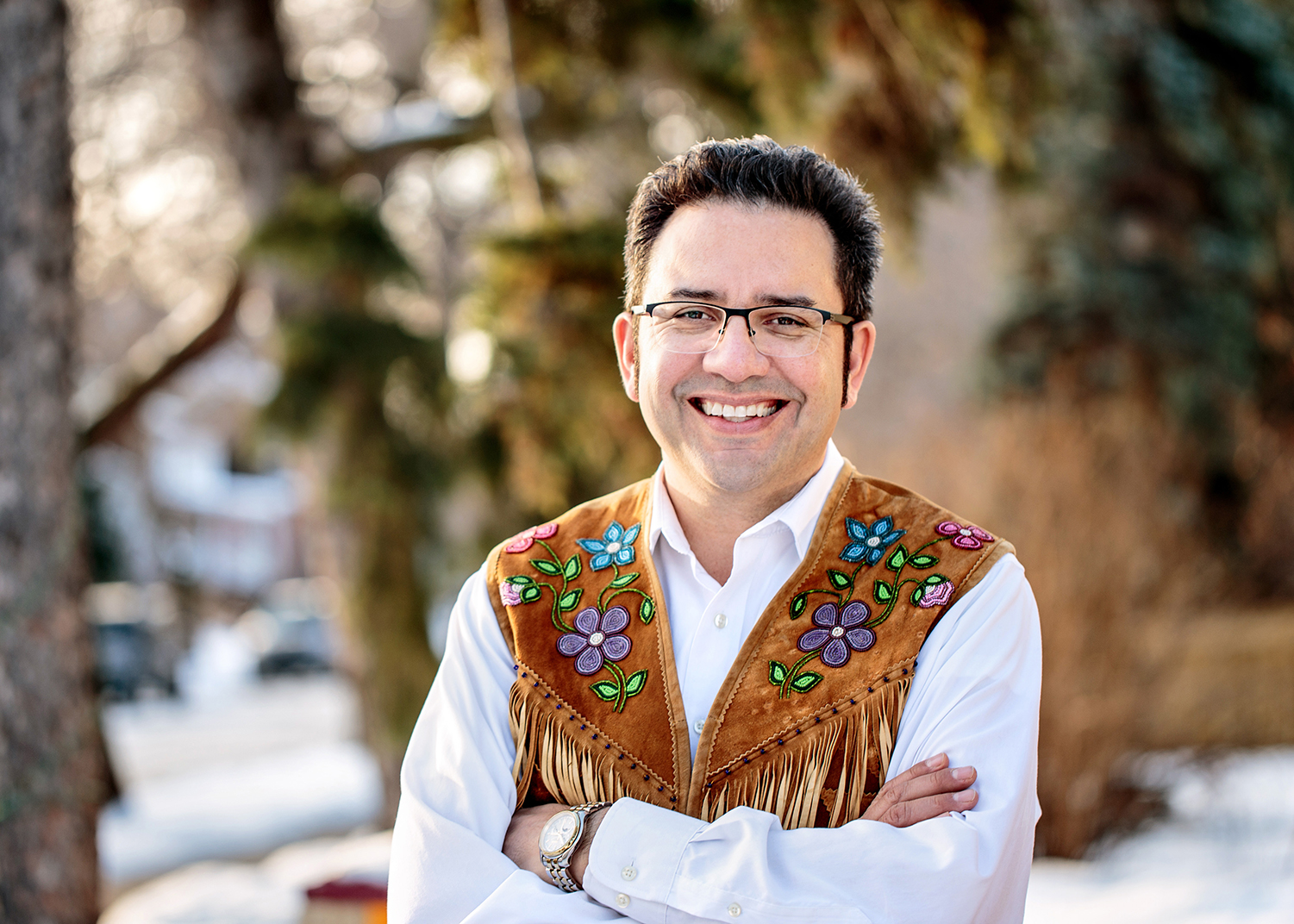
Richard Van Camp

Haa Huupa talk with Ry Moran

12:30-1:30pm Mon, Sept 28 • Fine Arts building room 106
Free • Details here

Organized by Fine Arts Indigenous Resurgence Coordinator Karla Point, Haa huupa — meaning “to share the teachings” in Nuu chah nulth — offers a chance to digest some Indigenous knowledge along with our food. This latest gathering features UVic’s Ry Moran (BA ’02), who was instrumental in advancing the Truth & Reconciliation Commission process in Canada, serving as the Director of Statement Gathering, and founding Director of the National Centre for Truth and Reconciliation.

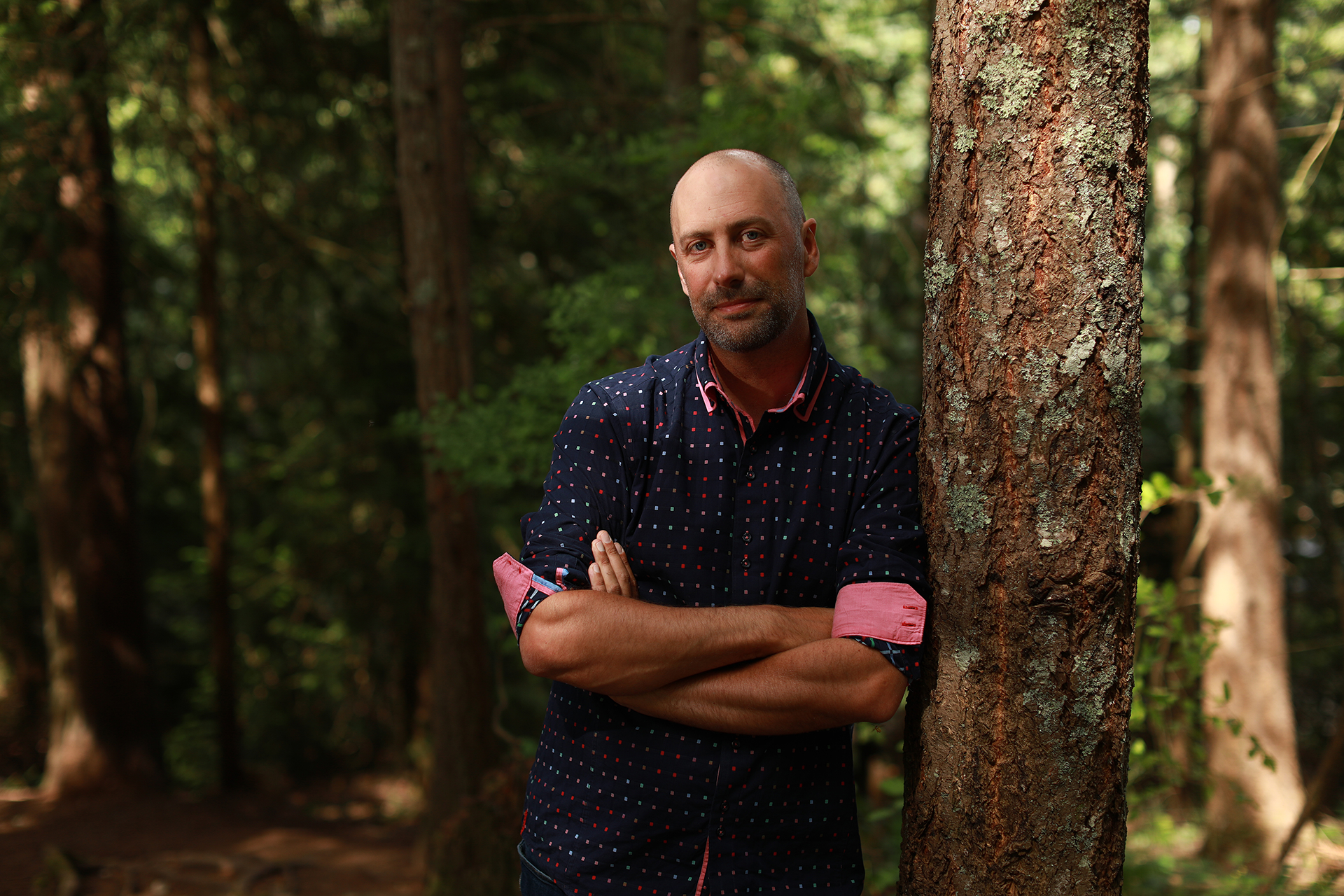
Ry Moran

Ry returned to UVic the Fall of 2020 as the inaugural Associate University Librarian – Reconciliation. His focus is to encourage others down a path of healing, reconciliation and human rights. The knowledge he brings to the position includes an academic background in political science and history at UVic, a gap year abroad and ten years doing the work of truth and reconciliation. He extends his work beyond academia, as he continues to engage with music production and recording to support the healing and empowerment of residential school survivors.

A multifaceted person with a rich history of service and leadership, Moran’s journey has not been a straight line. He recently served as the interim CEO of the Royal BC Museum, and he continues to contribute to music, education and reconciliation and he is dedicated to fostering understanding and healing within communities. His work continues to inspire and influence those who seek to bridge the gap between Indigenous and non-Indigenous people. He is a member of the Order of Canada (2026) and was awarded an Honorary Doctor of Laws from the University of British Columbia in 2024. He is a sought out speaker, commentator and writer.

Artist talk: Mike Dangeli on Reflections on Self-Decolonization as Reconciliation

5-6:20pm Monday Sept 28 • David Turpin Building Room A120 • Free

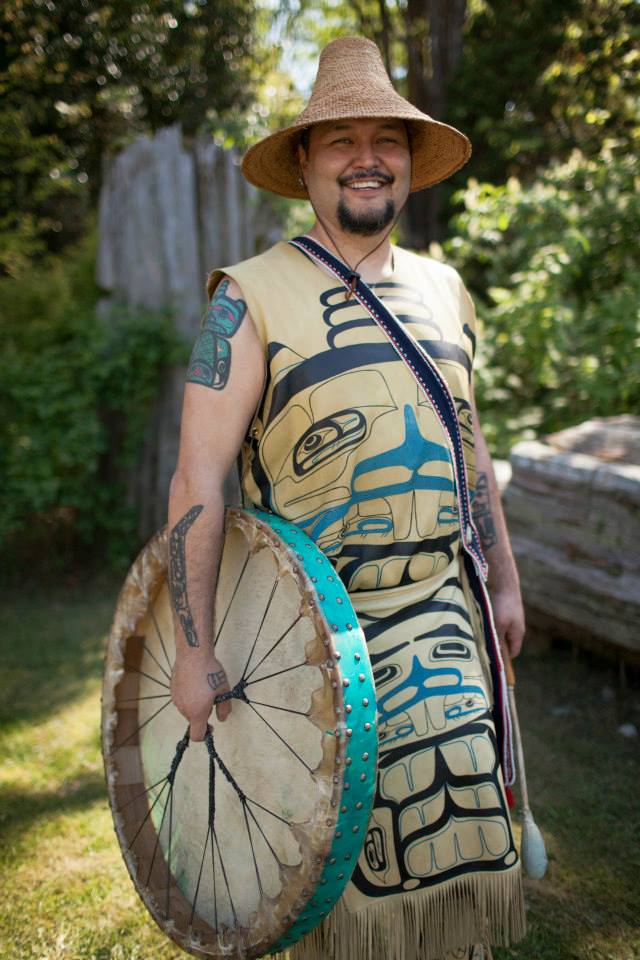
Mike Dangeli is a visual artist, singer, composer, dancer, educator and the current artist-in-residence with UVic’s Centre for Studies in Religion & Society. His talk is titled, “Lugyetga’nu Da Na Goadu (Returning Home to my Heart): Reflections on Self-Decolonization as Reconciliation” and problematizes the idea of reconciliation as a process that must always be inclusive of both Indigenous peoples and settlers. Through an ongoing process of self-decolonization, Mike has learned that if we are to ever to reach reconciliation, then more time, love and attention needs to be placed on our journeys to confront and heal from the effects of colonization individually and collectively as Indigenous peoples. Decolonization in, with, and for our own peoples is much needed before the process of reconciliation can begin.

Mike Dangeli is of the Nisga’a, Tlingit, Tsetsaut and Tsimshian Nations, and is in line to be a hereditary chief and has trained under the chiefs and matriarchs since his childhood. A renowned wood carver, painter, and designer, he began studying and creating his people’s art at an early age through traditional apprenticeships. His work is collected and exhibited throughout the world. For the past 20 years, Mike and his wife — AHVS professor Mique’l Dangeli — have trained three generations of dancers, singers and drummers in their dance group the Git Hayetsk. He has carved hundreds of masks and headdresses and made hand-painted leather regalia danced in the performances of Git Hayetsk as well as by many Nations and dance groups along the Northwest Coast.

Mike D’Angeli

Explore our latest Annual Review

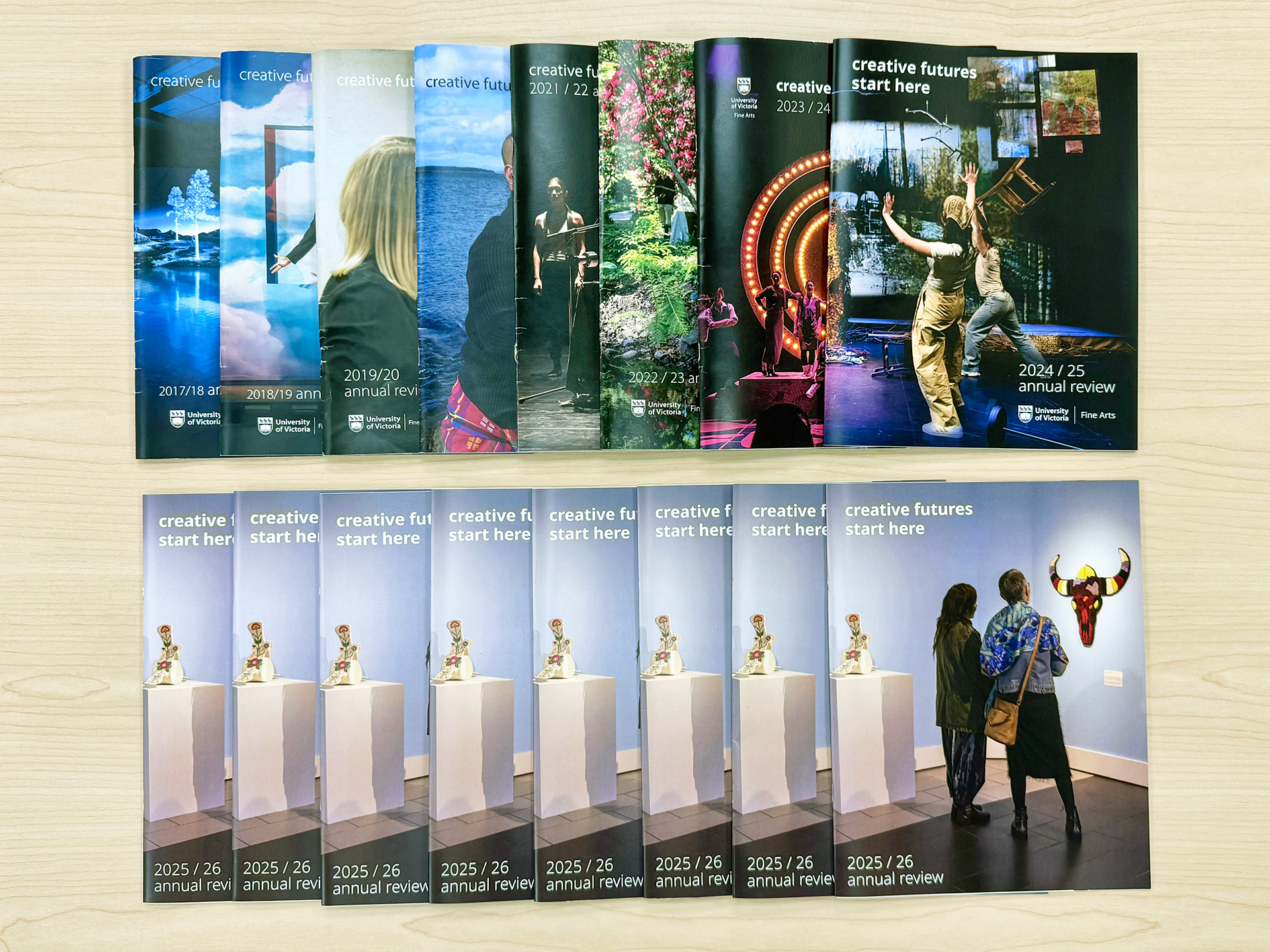
One of our favourite Fine Arts projects each year is the creation of our Annual Review: a glossy 36-page magazine featuring highlights from the most recent academic year. Inside our 2025/26 issue are a variety of stories exploring how our faculty, students, alumni, donors and community partners are working together in areas ranging from climate, technology and the environment to public health, AI and Indigenous research creation, to name just a few.

Education equates with action here in Fine Arts: we are committed to helping our students cultivate the skills needed to become innovative artists and engaged leaders. Our curriculum, research and artistic practices are all rooted in the power of creativity and experimentation to help us both understand and address today’s urgent issues.

With that said, and given that it’s a double-election month here in BC, let’s keep in mind the vital contribution the arts make — not only to our sense of wellness, vibrancy and community pride but also to our local, provincial and national economies.

According to 2024 statistics (the most recent available), BC has the highest proportion of artists in the labour force compared to any other Canadian jurisdiction (129,377 culture jobs) and BC’s culture GDP is the third highest in Canada ($11.4 billion). This continues a five-year upward trend, including a 44% increase in arts and cultural workers here in Greater Victoria — one of the highest growth rates in Canada. Nationally, a 2025 report found arts & culture contributed $131 billion to Canada’s GDP and supported over a million jobs nation-wide. And, since 2011, arts-sector spending growth has outpaced all other sectors — including oil and gas, construction, agriculture, manufacturing and both wholesale and retail trade — generating $17 billion in federal and provincial taxes.

Explore our 25/26 Annual Review here